
Great healthcare has always been a team effort.
Behind every successful treatment stands a network of people – doctors, nurses, lab specialists, administrators – each holding a piece of a puzzle. For care to be truly effective, every one of them needs to stay aligned, informed, and responsive to what’s happening in real time.
But that’s rarely the reality. Instead, healthcare teams frequently face a frustrating mix of missed updates, fragmented handoffs, and decisions that take too long to make. According to SOTI research, Code Digital: Will Healthcare Thrive or Survive, nearly two-thirds of healthcare organizations still rely on outdated technology, and clinicians lose about 3.9 hours per week to tech glitches alone.
These breakdowns don’t just cause stress. They can delay care, create unnecessary but preventable risk, and quietly erode the trust that clinical teams depend on. In an environment where every second counts, miscommunication isn’t just inconvenient – it’s costly in ways that go well beyond dollars.
The good news is that the tools to solve this problem already exist. Healthcare collaboration software – platforms that centralize communication, share updates in real time, and coordinate tasks across departments – has become an essential part of modern clinical practice. And the heart of it all is something deceptively simple: better communication between the people already in the room.
Why healthcare collaboration is harder than it looks?
Collaboration has always been at the heart of medicine. In the past, it meant hurried hallway chats, a nurse passing along a note, or a doctor scribbling patient details on paper. Records were handwritten – often in a script that could pass for ancient text – and updates were delivered by phone or in passing. To save time, doctors frequently gave verbal orders to nurses. In understaffed wards with constant interruptions, those instructions could easily be misheard, mixed up with others, or forgotten. The system functioned, but the risk of errors and delays was woven into its fabric.
As healthcare grew more complex, effective interprofessional collaboration became essential. A surgeon might perform an operation, but the pharmacist must verify the prescription, and the physiotherapist oversees recovery. No single professional can manage the entire process alone. Collaboration is no longer optional – it is the backbone of patient care.
Yet many healthcare systems still rely on tools from a previous era. The persistence of outdated practices is striking. In New Brunswick, more than one-third of physicians still rely on paper records. In Ontario alone, providers send an estimated 152 million faxes each year. These habits reflect a culture that favors familiarity and perceived “stability” over modernization – even when faster, safer digital tools are available.
The paradox is clear: healthcare can use AI for imaging or robotic surgery, yet still rely on fax machines for critical patient information. Advanced medicine cannot compensate for outdated communication between professionals.
Digital tools promised to change this reality. Key developments that reshaped collaboration include:
- Electronic health records (EHRs): Integrated access to comprehensive patient data across teams.
- Healthcare messaging apps: Secure platforms for instant communication and updates.
- Integrated collaboration tools: Systems that combine messaging, data sharing, and task management in one accessible space.
Adopting these solutions improved workflows, reduced duplication, and made coordination across departments faster and more reliable.
Paper vs Digital Collaboration in Healthcare
Discussions about healthcare technology often frame paper and digital systems as opposites – one safe and familiar, the other fast but risky. The reality is more nuanced. Each has genuine strengths, and the challenge is understanding both clearly rather than dismissing either.
| Aspect | Paperwork & Fax | Digital Systems |
|---|---|---|
| Reliability | Functions during blackouts, no system downtime | Vulnerable to outages, cyberattacks, and technical failures |
| Accessibility | Easy to use on-site, but difficult to share remotely | Instantly available across teams and locations |
| Security | Immune to hacking, but can be lost, stolen, or misfiled | Encrypted and access-controlled, yet exposed to large-scale data breaches |
| Efficiency | Time-consuming, prone to communication delays | Enables real-time updates and quicker decision-making |
| Scalability | Limited, disorganized as data grows | Handles complex patient histories efficiently |
| Collaboration | Dependent on physical presence or faxing | Supports cross-discipline, cross-location teamwork |
Paper offers resilience in moments when technology fails, but it cannot match the speed, reach, and depth of digital collaboration. The goal is not to eliminate one in favor of the other, but to integrate digital tools as the primary mode of coordination while keeping the alternative methods for when technology falters. Resilience and efficiency, not a binary choice.
What healthcare collaboration software actually does
Healthcare collaboration software has reworked the way medical teams work. With so many roles involved in taking care of a patient, from specialist doctors to administrators, these tools form the backbone of effective communication and teamwork. They aim to bring clarity and structure to the world of healthcare, which can get very complex with every second and every decision.
Fundamentally, the software solves one critical problem: making sure that all persons involved in patient care have the same data at the right time. In interprofessional collaboration in healthcare, where specialists from different disciplines must align their expertise, these platforms make sure that no update gets missed and there is no delay. For example, a cardiologist, a nurse, and a radiologist can instantly share insights, review data, and adjust the care plan without waiting for physical documents or emails to arrive.
At their core, these tools bring together several capabilities that used to live in separate systems:
- Secure team messaging: Encrypted, real-time communication between staff that replaces phone tag, unanswered pages, and miscommunicated verbal orders. Messages are logged, searchable, and tied to context.
- Integrated access to patient records: Connection to Electronic Health Record (EHR) systems so clinicians can pull up a patient’s history, medications, allergies, and test results without switching between applications.
- Task coordination: Clear assignment of responsibilities – who is doing what, by when – reducing the ambiguity that often leads to task fading in the air during busy shifts.
- Video and remote consultation: The ability to loop in a specialist from another location without requiring physical presence, which matters especially in regional settings where certain expertise is scarce.
- Patient-facing communication tools: Features that keep patients informed about their care plans, test results, and follow-up steps, reducing the confusion that often accompanies discharge or transitions between providers.
What makes this software unique is the simplification of complexity: instead of dealing with fragmented channels of communication and disjointed workflows, all can be pulled into one neat package. This quiets the noise, reduces misunderstandings, and enables professionals to devote more time to patient care.
The connection between team communication and patient outcomes
It can be tempting to treat internal communication as an operational concern – something completely separate from the clinical work of actually caring for patients. The evidence suggests otherwise.
Communication failures are consistently identified as a leading contributing factor in adverse clinical events. When a nurse cannot quickly reach a physician, when a medication order is misheard, when a specialist doesn’t recieve an updated test results before a procedure – these aren’t just administrative inconveniences. They’re moments where patient safety is at risk.
The reverse is also true. When teams communicate clearly and quickly, the clinical benefits are measurable. Decisions get made faster. Errors get caught before they reach patients. Handoffs between shifts happen with fewer gaps. Follow-up care is more consistent. Patients feel better informed and more engaged in their own treatment when clinical backrooms are in sync.
Where the impact is felt the most
Emergency settings offer the clearest illustration. When a trauma patient arrives, the attending physician needs immediate access to the patient’s history, known allergies, and current medications. Notifications need to reach on-call specialists. The surgical team needs to prepare. With the right communication infrastructure, all of this happens in parallel, almost in the blink of an eye. Without it, staff making calls, searching through paper files, and waiting – while the clock runs.
The benefits extend beyond emergencies. Chronic disease management, post-surgical recovery, and mental health treatment all depend on coordinated follow-up across multiple providers over extended periods. Healthcare collaboration platforms ensure that every point of contact – from the primary care physician to the specialist to the community nurse – is working from the same picture. This consistency reduces the gaps in care that often lead to readmissions.
Administrators and support staff benefit from this as well. When care coordinators, medical receptionists, and billing teams can access relevant information without hunting across departments, the whole system moves more smoothly; fewer delays, less duplication, and a more responsive experience for patients.
The burnout connection: Why communication tools matter for staff
Healthcare professionals face immense pressure every single day: long hours, life-or-death decisions, and a constant flood of information. It’s no surprise that burnout has become the silent pandemic in hospitals and clinics around the world. Ironically, communication – the very thing that’s meant to keep teams on the same page – typically ends up being a major source of stress.
Imagine a nurse juggling hundreds of messages, calls, and emails while keeping up with patient care. Important updates get lost in threads, calls go unanswered, and critical information can be missed. This constant barrage drains mental energy and leaves little room for focus or recovery. No wonder 65% of nurses report high levels of stress and burnout. Key contributors include short staffing, inadequate pay, lack of leadership support, and patient abuse. Every distraction or miscommunication increases errors, reduces job satisfaction, and makes it harder to provide effective care.
Clinical communication platforms and emergency texting systems don’t solve the systemic pressures of healthcare work. But they can meaningfully reduce the communication overhead that consumes time and attention that should be directed at patients. Centralizing messages, tasks, announcements, and files in one accessible space reduces context-switching. Priority notifications ensure that urgent information gets seen without every message demanding the same level of attention. And when teams trust that information will reach the right person reliably, there is less duplicative checking, less anxiety about something getting lost in the chaos.
Reducing that background noise doesn’t just save time. It helps protect the focus and cognitive capacity that clinical staff need to do their best work.
Essential features to look for in healthcare collaboration platforms
When you’re shopping for healthcare collaboration software, you need to consider features that will affect your day-to-day practice in a direct way. Healthcare is a high-paced setting, and the software that you implement has to seamlessly become part of the workflow to help facilitate improved communication and more effective care. Let’s examine the key features more closely to be aware of and how they can have an effect on the real world.
1. Real-time messaging and instant updates
Speed and security in messaging are a lifesaver for healthcare. No matter where you are working – a bustling ER or specialist’s office – the ability to exchange instant messages between employees allows important information to flow immediately, without the delays of phone calls or paperwork backlog.
For example, in a busy trauma center, when a patient is being transferred for urgent surgery, the surgeon, anesthesiologist, and nurses can exchange vital information in real time. No lost time, just immediate action fueled by real-time communication. Such smooth integration reduces the risk of miscommunication and enhances patient outcomes.
2. Integrated access to patient records
Medical communications systems today are structured to blend with your existing EHR infrastructure, so all caregivers involved in the patient’s care have identical, up-to-date information. This is especially effective within multidisciplinary treatment settings, i.e., within oncology or cardiology practices, where there are numerous specialists that need concurrent access to the patient’s record and lab results.
Suppose a cardiologist is reading through a patient’s EKG and talking to the pulmonologist face-to-face during a consult. Rather than waiting for papers to be exchanged, they do it in real time, examining records together and making treatment modifications as necessary. This integration breaks down the departmental silos, enhancing the coordination of care throughout.
3. Task management and coordination
In a healthcare setting, things need to be unambiguous. A task management feature pierces the ambiguity that arises in high-speed situations. Instead of relying on verbal reports or sticky notes, employees can assign specific tasks – whether administering medication or preparing for an upcoming procedure. Each member of staff knows what they are to do at any given time.
Take, for example, a surgical team preparing for a procedure. The anesthesiologist, surgeon, and nurse can all have their roles individually assigned in the system. The nurse can confirm that all of the pre-op tests are completed, the surgeon confirms the operating room, and the anesthesiologist prepares the medication – all orchestrated through one platform.
4. Video conferencing and telemedicine capabilities
When specialists are distributed across various areas, video consulting from healthcare networks is a necessity during consultations. The feature facilitates remote access to the best physicians in the country – or even abroad – when there is a need. It is particularly useful in shortage areas of certain specialties to ensure all patients receive specialist attention regardless of where they are.
Imagine a neurologist visiting with a country physician on a stroke patient. They can share diagnostic images and discuss a plan of treatment collaboratively in real time, rather than waiting for travel or on-site visits.
5. Patient engagement features
One should not overlook taking into consideration how the software can enable better engagement with patients, as well. A good patient communication platform doesn’t just send patients reminder notices for their appointments – it enables them to message their providers directly, get lab results, and schedule follow-up appointments. It is an aid to a sustained relationship, enabling patients to better manage their health while more personally attending to them.
Take the case of a mental health clinic where patients are encouraged to remain in touch with their therapist via secure messaging. If someone feels overwhelmed or needs advice between sessions, they can reach out directly, and their therapist can respond promptly, without having to schedule an official appointment. This level of ongoing communication leads to greater engagement and, ultimately, increased patient satisfaction and outcomes.
6. Security and compliance
With healthcare, protecting sensitive information is of utmost importance. Look for platforms that are HIPAA (Health Insurance Portability and Accountability Act) compliant and other security standards relevant. Such practices help to protect patient confidentiality and provide data security against violations.
Let us take the example of an online care session with a remote patient. You are required to maintain every conversation and medical information shared in the session as confidential. A secure platform is where the doctor and patient feel safe talking without hesitation, confident that their data is protected.
Risks of healthcare collaboration software: what to watch out for
While healthcare collaboration software offers considerable benefits, one must recognize that, with its implementation, there also come potential risks. These tools have revolutionized the way healthcare teams work, but just like any technology, they bring along challenges that one should be careful about. Understanding the risks upfront leads to better implementation decisions and fewer unpleasant surprises.
1. Data security and privacy concerns
The biggest risk related to healthcare collaboration software could be the security of patient data. As health information will be transferred among participants across different platforms, its breach might cause irreparable harm. There are also constant risks from cyber-attacks; even highly protected systems cannot fully resist these kinds of attacks.
How to prevent it:
- Select software that is HIPAA-compliant and adheres to other rules on privacy.
- Ensure the platform uses end-to-end encryption to safeguard data.
- Periodic security audits and updates become necessary to outsmart emerging risks.
2. Integration with the existing systems
The biggest challenge for healthcare organizations is integrating these new collaboration tools with the existing systems. Clinical environments have usually grown into a mix of old legacy software, making seamless integrations challenging. Badly done integrations risk creating fragmented data or inconsistent workflows.
How to prevent it:
- Invest in collaboration tools that offer frictionless integrations with Electronic Health Records systems.
- Collaborate with IT departments to make the transition easy and migrate the data.
- Pre-test the systems before fully implementing them in order to identify any integrating issues and fix them.
3. User adoption and training
Technology is only as good as those people using the technology. The best-in-class healthcare collaboration software can fail if the staff are not trained properly. After all, there will be people who resist the change, having been used to older, manual systems.
How to avoid it:
- Provide extensive training programs that will make the staff get comfortable with the new software; create clear documentation and guides for easy reference. Encourage a culture of collaboration where every team member is on board with the new tools.
4. Over-reliance on technology
With so many communication tools in place, there’s a risk that teams might become too reliant on software and lose sight of the human side of collaboration. Sometimes, a face-to-face conversation or a phone call might be more effective than a digital message.
How to prevent it:
- Foster a balanced approach where digital tools complement and do not replace direct communication.
- Hold regular in-person or virtual team meetings for rapport and building trust.
5. Work process disruptions
Introduction of new technology often disrupts processes at work, leading to delays or confusion while staff get used to the new setup. Such disruptions, if not well planned, may harm efficiency and even cause errors in care.
How to avoid it:
- Do phased rollouts to minimize disruptions and give ample time for adaptation.
- Gather feedback from users in the early days to spot pain points and make adjustments.
- Observe workflows after implementation to ensure a smooth operation.
These are risks, but they do not outweigh the benefits. With the right precautions and proactive planning, healthcare teams can mitigate issues that may pop up and make sure healthcare collaboration software improves both care and communication. It is all about the balance between innovation and careful implementation. As these tools continue to evolve, so too will the ways to manage their risks effectively.
Ethical and privacy concerns in healthcare collaboration platforms
While healthcare collaboration software promises much, it also carries heavy responsibilities, particularly in respect of privacy and ethics. After all, these tools deal with the most sensitive information imaginable. So, how do we make sure they are used safely without stepping on ethical landmines?
It’s not just a matter of safeguarding patient data against some hacker, but also protecting it from misuse, intentional or otherwise. Here, HIPAA compliance is not something to be debated when selecting healthcare collaboration platforms. If the software doesn’t meet the set standards, that should raise a red flag. Additionally, basic features should be the use of end-to-end encryption to ensure privacy regarding where such data is shared. The last thing any health care provider needs is a leak in their data because of an outdated security protocol.
But privacy is not just about the security of the data; it is also about how much access is given. In a world where everybody knows everybody, it would be very easy to share all with all. But oversharing clouds the waters, and not all information is necessary for every team member. It is a delicate balance between transparency and restraint-sharing the right info with the right people at the right time.
On the ethical side, collaboration software can easily become a crutch: relying too much on automated systems could push the human element to the sidelines. Of course, the software can make decisions faster, but can it replicate the empathy of a nurse who notices a change in a patient’s condition? Technology can’t-and shouldn’t-replace human judgment. It should support it.
Finally, there is informed consent. The patient has a right to know what will happen with their data once they put them into the system. Transparency above all. If one feels that privacy is not an issue, treatment engagement is more productive, and more trust in the treatment system is generally developed.
Operational considerations:
- Ensure protection of patient information through HIPAA compliance and encryption of data from end-to-end.
- Be mindful of oversharing: Share only what is relevant with the right people.
- Don’t let technology replace the human touch; it’s there to assist, not replace.
- Always inform patients about how their data will be used and shared.
Put another way, healthcare collaboration software has the potential to upend care – but only if it’s handled with care. If privacy is paramount, ethics are used, and patient trust remains intact, these can actually enhance healthcare without crossing the lines.
Where Chanty fits in
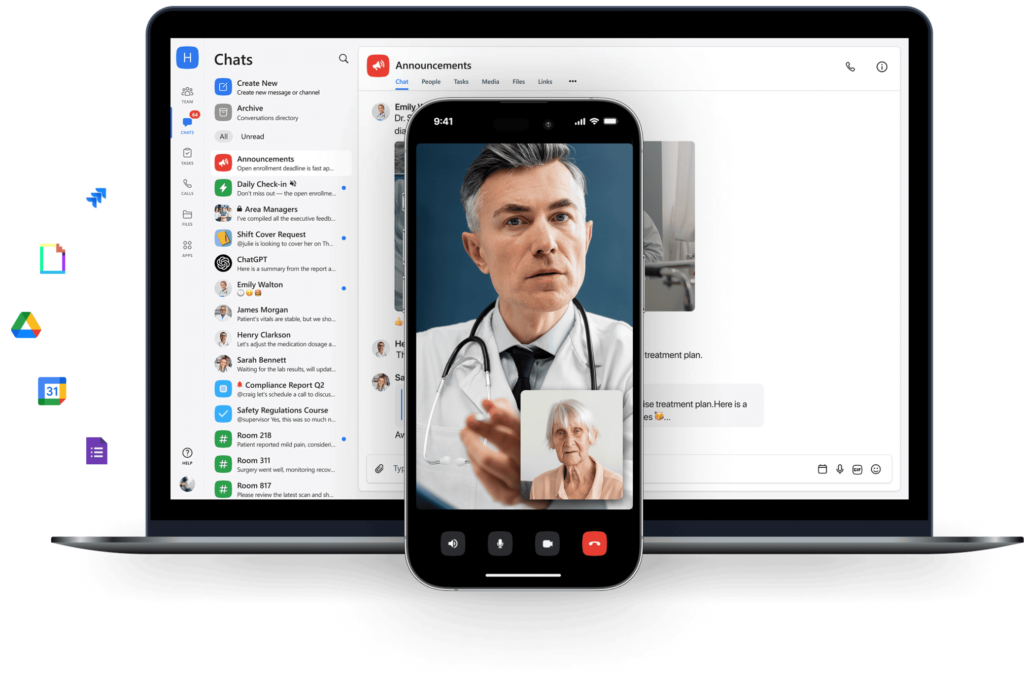
Chanty wasn’t built specifically for healthcare – and that transparency matters to us. We’re a team communication and collaboration platform that was designed to make it easier for people to work together clearly and efficiently, in any environment where coordination is critical and digital noise is a problem.
Over time, we’ve been fortunate to work with clinics, care teams, small practices, and other healthcare institutions that found that our platform’s strengths mapped well onto their daily communication challenges. Most of the time, the hardest part of their work isn’t the clinical decisions themselves – it’s the background friction of keeping everyone aligned: who knows what, who’s handling what, what changed since the last shift, where to find that file.
That’s the problem Chanty is built to address. Not as a patient management system, not as a replacement for an EHR – but as a communication layer that makes coordination feel less like overhead and more like a natural part of how the team works.
What that looks like in practice
Real-time messaging with file sharing: Test results, MRI imaging reports, and treatment notes can be shared instantly in secure, searchable threads. Voice messaging is available for moments when there’s no time to type.
Built-in task management: Any message can be turned into a task with one click, assigned to a specific person, with a deadline and a @mention notification. Responsibilities become visible and trackable within the same space where communication happens.
Security for sensitive environments: Chanty follows HIPAA standards and offers IP Allowlist controls on Business and Enterprise plans, ensuring that access is tied to being with the institution’s network. When staff leave the facility, access is automatically restricted.
Low friction onboarding: We designed the platform to be intuitive from the first session. Healthcare staff are already navigating complex systems – Chanty shouldn’t add to that load.
Integration flexibility: While we don’t offer native EHR integrations out of the box, we approach each healthcare organization’s needs individually. In many cases, custom integrations can be built within days. If that’s important to your team, it’s a conversation worth having.
We think of Chanty as background infrastructure for care teams – the kind that gets out of the way and lets people focus on patients rather than shift logistics.
How to successfully implement collaboration software in healthcare
Technology alone doesn’t improve healthcare – how it’s integrated into daily practice does. After all, even the most advanced healthcare communication systems won’t help if professionals find them confusing or disruptive. The key is to introduce these tools in a way that complements existing workflows rather than complicating them. So how do healthcare providers ensure a seamless transition?
1. Choose software that aligns with real-world needs
A hospital communication app must fit the pace and complexity of healthcare environments. Before selecting a solution, ask:
- Does it integrate with electronic health records (EHRs) for immediate access to patient data?
- Can it handle secure messaging between specialists, nurses, and staff without delays?
- Does it support non-verbal patient communication tools for individuals with speech impairments?
For example, emergency teams benefit from instant messaging platforms that speed up decision-making, while outpatient settings might prioritize task management features to coordinate long-term care.
2. Ensure it’s intuitive and easy to use
A patient communication platform should reduce stress, not add to it. If staff members need weeks of training, adoption rates will plummet. User-friendly design is non-negotiable – look for software with:
- Mobile compatibility so doctors can check updates on the go
- Minimal clicks to complete tasks, avoiding unnecessary navigation
- Customizable notifications to prevent alert fatigue
For instance, an ICU nurse juggling multiple patients doesn’t have time to search for critical updates. A platform with color-coded priority alerts ensures urgent information stands out without overwhelming staff.
3. Prioritize security and compliance from day one
Security missteps aren’t just risky – they’re legally and ethically unacceptable. HIPAA-compliant patient communication software must be the standard, not an afterthought. Implementation should include:
- Automatic encryption for all messages and file transfers
- Role-based access controls, ensuring only authorized personnel view sensitive data
- Two-factor authentication (2FA) to prevent unauthorized logins
For example, a telemedicine provider using a hospital communication app should ensure that patient data remains encrypted even when transferred between departments or external specialists.
4. Train staff in practical, role-specific ways
Generic training rarely sticks – customized, hands-on learning works best. Healthcare teams should:
- Run scenario-based training, such as handling time-sensitive medication orders via the platform
- Assign peer mentors to help colleagues adapt
- Start with small pilot teams before a full-scale rollout
Consider a large teaching hospital implementing interprofessional communication software. Instead of overwhelming all departments at once, they could first train ER staff, where fast, clear messaging is most critical, then expand gradually.
5. Make collaboration part of the culture
Technology is just a tool – team buy-in is what makes it successful. Encourage:
- Regular feedback sessions to refine workflows
- Open discussions on how digital communication impacts patient care
- A mindset that technology should support, not replace, human interaction
For example, a patient communication platform should never replace bedside manner but instead enhance it – allowing doctors to review updates in seconds so they can spend more time with patients, not screens.
Conclusion
Healthcare collaboration is the immediate future. The appropriate tools do make all the difference in the manner in which a team wishes to collaborate with greater brains and speed. Proper healthcare collaboration software will thus ensure better communication, quicker decisions, and ultimately better care for the patient. It is now time to welcome such collaboration tools – your teams and patients would thank you.
Of course, even the best healthcare communications system will only be as good as its implementation. By choosing the right tool, properly training employees, and continually refining its integration, healthcare teams can maximize efficiency without sacrificing the human element. Well-executed, collaboration software is the behind-the-scenes support facilitating care, decisions, and patient outcomes.
At Chanty, we’ve seen firsthand the difference that better communication can make to how teams work – streamlining each day, making it more coordinated, and less hectic. That’s why we’re committed to helping healthcare organizations cut through the noise, stay aligned, and keep their focus on what really counts: delivering great care with no unnecessary complexity. If that’s what your team needs, we’d like to show you how Chanty can help. Let’s get in touch.
FAQ
What is healthcare collaboration software, and why is it important?
Healthcare collaboration software is a digital platform that connects doctors, nurses, specialists, and administrative staff to streamline communication, share patient data securely, and coordinate tasks. It’s important because modern healthcare relies on rapid, accurate teamwork – delays or miscommunication can compromise patient safety and increase stress on staff.
What security standards should healthcare collaboration tools meet?
At minimum, any platform handling patient information in a U.S. healthcare setting must be HIPAA-compliant. Look for end-to-end encryption for messages and file transfers, role-based access controls, audit logs, two factor authentification, and clear data breach response protocols. Security should be a design principle, not a compliance add-on.
How does collaboration software improve patient care?
By centralizing updates, providing real-time messaging, and integrating with electronic health records, collaboration software ensures that all caregivers have the same accurate information when making decisions. This reduces delays, avoids errors, and allows teams to respond quickly to emergencies or ongoing treatment needs.
Is using digital collaboration software safer than traditional paper-based methods?
Digital platforms are faster, more accessible, and support complex workflows, while paper is resilient to power outages and cyberattacks. The safest approach balances both: use digital systems as the main mode for real-time coordination, but maintain contingency methods for critical moments when technology might fail.
What features should I look for in healthcare collaboration tools?
Key features include real-time messaging, secure file sharing, integrated patient record access, task management, video conferencing, patient engagement tools, and robust security measures like HIPAA compliance and encryption. Each feature supports faster, clearer, and safer communication across teams.
How do collaboration tools help with burnout?
Communication fragmentation – the experience of juggling too many channels, hunting for information, and managing constant interruptions – is a significant contributor to healthcare worker stress. Centralizing communication and task management in one accessible platform reduces context-switching and the cognitive overhead of tracking down information, freeing staff attention for the clinical work that matters most.
Can collaboration software handle emergency situations effectively?
Yes. Emergency scenarios benefit from instant access to patient data, rapid notifications to on-call specialists, and streamlined communication that supports immediate, coordinated decisions. This reduces delays that could impact patient outcomes.
What are the privacy and ethical considerations?
Software must be HIPAA-compliant, encrypt all communications, and restrict access based on roles. Oversharing should be avoided, and patients should be informed about how their data is used. Technology should assist human judgment, not replace empathy and professional care.
What are the main risks of implementing healthcare collaboration tools?
The most common challenges are data security. integration with legacy systems, staff adoption, and the risk of over-relying on digital tools at the expense of direct human communication. All of these are manageable with proper planning, phased implementation, role-specific training, and an ongoing feedback loop with the staff who use the platform daily.
Why choose a platform like Chanty for healthcare teams?
Chanty offers real-time messaging, secure file sharing, task management, and an intuitive interface designed to reduce tech fatigue. It prioritizes HIPAA compliance, easy onboarding, and supports coordination across shifts and departments, helping teams act faster without compromising privacy.